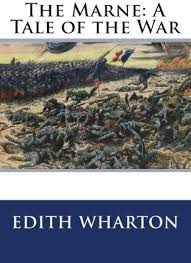
In light of the recent and ongoing geopolitical conflicts, I thought it fitting to revisit Edith Wharton’s 1918 wartime novella, The Marne: A Tale of the War. It may be surprising to some still unfamiliar with Wharton to know that she produced not one, but two full-length stories of World War I, the other being A Son at the Front (1923). And I must say, her wartime fiction is just as much a delight as is her fiction focused on the upper class. They both, along with her extensive wartime non-fiction, exude a certain undeniable pathos, an empathetic illustration of a people, on both sides of the Atlantic, thrust into the machinery of war.
Contemporary readers of Wharton’s time were not as enamored. Many thought her first wartime novella, as well as many of her war-themed contributions to American magazines, were too sentimental or propogandistic to be relatable. Not only that, but by the time A Son at the Front was published, the general public was already and long exhausted with the drain and drudgery of the war, and were not particularly keen to hear what anyone, even the talented chronicler Wharton herself, had to say about it anymore. For too long, Wharton had urged her American compatriots to abandon their position of neutrality and rally behind the Allied forces on the European continent. But by the time the United States entered the war, most were eager for it to be over, and counted upon the American forces to expedite its closure.
Upon reading The Marne, however, especially for the first time, I can’t help but be struck by its romanticism and its good-heartedness that uplift the main character, American Troy Belknap, and his aspirations to join the Allied forces on the front. What especially motivates him is the loss of his good friend and tutor, Frenchman Paul Gantier, at the front. Eventually, and because of this inspiration, and because he is too young to enlist, Troy volunteers as a driver for an ambulance brigade that will take him nearly all the way to enemy lines in the second Battle of the Marne. He encounters many characters and obstacles along the way, and even finds the makeshift grave of his friend and confidante, M. Gantier.
Wharton strives for her readers to recognize Troy’s apparent inability to process the horrors of the war, and how he instead idealizes it, turning it into something mythic and foreboding. However, Wharton also makes sure that her readers recognize, if not Troy himself, the effect that the looming presence of the war has on its environs, despite its small victories:
“Then came the day when the advance was checked. The glorious counter-attack of General Mangin gave France new faith in her armies, and Paris irrepressibly burst at once into abounding life. It was as if she were ashamed of having doubted, as if she wanted, by a livelier renewal of activities, to proclaim her unshakable faith in her defenders. In the perpetual sunshine of the most golden of springs she basked and decked herself, and mirrored her recovered beauty in the Seine. And still the cloudless weeks succeeded each other, days of blue warmth and nights of silver lustre; and still behind the impenetrable wall of the front, the Beast dumbly lowered and waited…“
To perhaps put this vision of the war into our own contemporary perspective, we see that it is easy to lose sight of war’s horrors and atrocities. Being so far removed from the site of combat and conflict, it becomes easy to celebrate the smallest victories, and perhaps even think these are cause for hoping that the war is near its end. But this of course is merely an illusion, because as war rages on, we return to the status-quo of our lives, the “livelier renewal of activites,” all while perhaps pretending that war has no or little effect on our daily routine. To counteract this, we must think of Troy Belknap. Troy understands the pervading reality of war and is eager to contribute whatever he can. He is full of confidence and gusto, and will not rest until he himself partakes in the exchanges of the front — “Ah yes, he would do that, Troy swore — he would do it on the battlefields of France.” — quoted as the novella ends. And it is only once we adopt Troy’s remarkable ability to remain cheerful in spite of hardship, to do all he can until the world finds peace in chaos, that we ourselves will understand the world and its contradictions more distinctly.


October 27, 2026 at 8:50 am
Thanks for sharing. I love your blog! I haven’t read this, but after reading your post – and the passage from the book – I have decided to add it to my reading list.
LikeLiked by 1 person
October 27, 2026 at 4:27 pm
Thank you, Mary!! I’m thrilled to introduce you and others to Wharton’s war fiction, and if you give it a chance, I think you will be surprised with its power and relatability!! Enjoy!!
LikeLike