
Search

Red Pickle Dish

Edith Wharton Revisited

Tag

tragedy

Summer in Winter

On this official last day of winter, with balmier seasons ahead, I thought it appropriate to revisit Wharton’s oft-neglected novella to postulate something that may or may not have had an effect on her characters, plot, and ending: what would Summer have been like had Wharton set the story in winter, like her Ethan Frome??

The novella begins as thus:

“It was the beginning of a June afternoon. The springlike transparent sky shed a rain of silver sunshine on the roofs of the village, and on the pastures and larchwoods surrounding it. A little wind moved among the round white clouds on the shoulders of the hills, driving their shadows across the fields and down the grassy road that takes the name of the street when it passes through North Dormer. The place lies high and in the open, and lacks the lavish shade of the more protected New England villages. The clump of weeping-willows about the duck pond, and the Norway spruces in front of the Hatchard gate, cast almost the only roadside shadow between lawyer Royall’s house and the point where, at the other end of the village, the road rises above the church and skirts the black hemlock wall enclosing the cemetery.”

It is easy to observe the contrast here. Wharton would have you believe that the setting is nothing but warm, pleasant, and bucolic, this put in stark relief against her Ethan Frome, which is an icy tale full of woe and misery. The reader is led towards a positive outlook, perhaps to think that all that is to follow will have a satisfying outcome, a stereotypical “happy ending.” After all, who doesn’t like the weather in June?? And how could any of Wharton’s characters be unhappy in such a dreamy place??

Put under a microscope, however, we are led to something quite different. As readers of Summer, we know that the ending is not ideal, and that her characters, at least her main character, Charity, do not end up particularly happy or satisfied. Charity, like Ethan, is looking for an escape, a chance to break free from her confines, because, to her, this summer landscape is stifling and restrictive. Our minds thereby travel to what the extreme of summer looks, and feels, like at its harshest. The heat and humidity is indeed stifling, and most people do not venture outdoors. The same is true for the winter, in which the drifts of snow and icy temperatures keep most people home bound. So, we can deduce that the extremes of each season leads certain characters, whether in fiction or in real life, to a sort of “cabin fever” effect, where the effects of atmosphere, temperature, and precipitation are prone to driving people to their limits.

And it is this propulsion to the limit that we see affect both Charity and Ethan. It does not matter the season. The extremes of each is what hurtles each character to their individual, but identical fates. Would Charity have indeed escaped North Dormer had Wharton set the story in the winter?? Would Charity have been more resourceful, or more inspired to break free had the winter had its grip on North Dormer?? And inversely, would Ethan have had better luck escaping Starkfield had Wharton set his story in the summer?? It behooves the reader to conclude that, no, it does not matter for Charity or Ethan whether it is summer or winter. We see the glimpses into their identical fates, which ultimately lead to their spiritual destruction. It is evident and foreshadowed in the passage quoted above, where the road ends, just as Charity and Ethan’s stories end, in a place of death, the cemetery.

Readers ultimately mourn for and empathize with Charity and Ethan. But it is at Wharton’s hand that we see their fates played out in the harshest ways. Wharton, in her time, had to bring her characters to such extremes to light attention to the plight of rural men and women of her era. For such people, there were few opportunities for escape or improvement. What we normally observe as the change of seasons in the most delightful of ways were mechanisms of torture for her characters. And perhaps once that warm summer sun pokes over the horizon, or the first snow of winter blows our direction, we’ll remember them more profoundly.

***Stay tuned for more posts!! This June, I will be attending the Edith Wharton Summit 2026 in Lenox, Massachusetts!! So, I look forward to having a plethora of material for future content. Enjoy, and Happy Spring!!

May I? — A Poem on War, Unrest, and a Centenary of Change

May is not always just a month of change, it is a month of reflection, revival, and growth.

Not just in seasonal and allegorical ways, either, but in historical, individual ways.

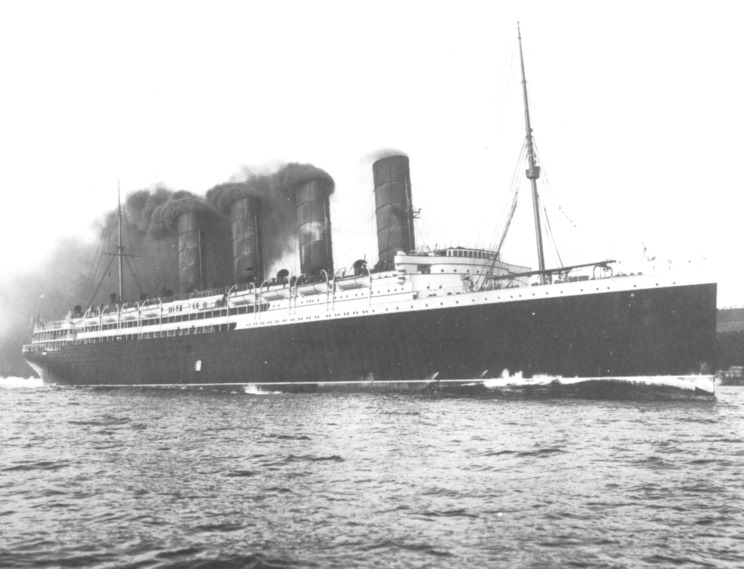
On May 1, 1915, the RMS Lusitania set out from her American port en route to Liverpool. She was a ship of wonder, the equivalent of The White Star Line’s Titanic, famously lost three years earlier, a rival of the Cunard line’s crowning glory, and icon of Edwardian engineering and maritime pride.

She never made it back home through the ‘war zones’ of Britain, and fell in spectacle on May 7, 1915, to the bottom of the sea, seven miles off the southern coast of Ireland, in vantage point from the lighthouse that caps the cliff of ‘The Old Head of Kinsale’; with 1,198 souls lost, many of them Americans, the murder of the Lusitania outraged the American public, and set off a spark of American involvement in the growing war in Europe. Sailing through hostile German naval territory, the Lusitania was torpedoed on her starboard side by a German U-boat, and sunk in eighteen minutes. Not only a catastrophe in it’s own right, a turning point that would herald the first ever global war, ‘An End of Innocence’, a catharsis of ideals, and an American cultural revolution, but the bringing to life of new ideas, and the sobering rethinking of mankind’s expressions of ingenuity, ones that would shift from technological marvels like the Lusitania to other modes of individual, literary, and artistic ‘expression’ that would emerge through and beyond ‘The Roaring Twenties.’

Of course, I cannot help (again) to make parallels with the currents of protest now running through the nation. The uprising in Baltimore, though in a sense drastically ‘different’ from the chain of events, the loss of the Lusitania being one of them, that initiated a global crisis, is also in another sense remarkably similar — it is another distinctly ‘American’ opportunity to embrace change.

Did Wharton see the sinking of the Lusitania as the end of her ‘beloved’ (sarcasm, of course) Gilded Age ideals? Her purpose for her writing? The transformation of tragedy and unrest into a rethinking of ‘American’ values? I really have no clue, and I’m not sure that the opinions of a rich, privileged, dead white woman at this point could really lend much value towards a conversation about chronic, race-based inequality and unrest in 21st-Century America. 🙂 But it is certain that the Great War that followed catapulted her desire into assisting directly on the front lines and in the relief effort. And, I will speculate, that May 1915 may have been the month, the year, the ‘turning point’, the true wake-up-call for not just America and the world on the heels of war, but for the cynical, the brusk, the inert, the snobbish Edith Wharton, to leave her pen and paper, her failed marriage, her elaborate estate, behind, and spread the light that she had once so brashly and mercilessly denied all of her characters — and to some extent, herself — into the lives of real people, other people, people caught up in the turmoil of World War One.

May 1915. This, not all but just Wharton could likely see, was a, if not the, definitive moment of the century, the ultimate uprising and unrest of a generation, the spark of change that would, perhaps, ‘make all else clear’ …

………………………………………………………………………………….

………………………………………………………

………………

~ May I?

 Remembering the Lusitania ~

……..

May 2015 … bring forth fruit.

May 2015 … bring back light.

May 2015 … tear down hearts of stone.

May 2015 … raise up spirits of truth.

May 2015 … uproot the weeds of fear.

May 2015 … plant the seeds of love.

May 2015 … be not month, year, but purpose.

May 2015 … revive, restore, souls, bound by time.

May 2015 … renew polluted minds.

May 2015 … release the ties that bind.

May 1915 … bring us through these wars.

May 1915 … bring our nation hope, color, glory, again.

……..

~ Lusitania! She is not dead! She has been sailing with us all along. ~

………………………………………………………………………………….

………………………………………………………

………………

08_lusitania

Unearthing Ethan Frome

“He seemed a part of the mute, melancholy landscape, an incarnation of its frozen woe, with all that was warm and sentient in him fast bound below the surface; but there was nothing unfriendly in his silence. I simply felt that he lived in a depth of moral isolation too remote for casual access, and I had the sense that his loneliness was not merely the result of his personal plight, tragic as I guessed that to be, but had in it, as Harmon Gow had hinted, the profound, accumulated cold of many Starkfield winters.” –Ethan Frome

I had always wondered why, during my “summer reading” for my high school junior English class, I was strangely drawn to this immensely sorrowful and pathetic novella. Most students revile it, or cannot tolerate its almost unjustifiable and insufferable pathos: why would a writer subject her characters to such extreme, abject suffering?

Though many people despise the story, most all of them could probably recall how it ends (no spoiler alerts here): Ethan, a passionate, spirited, intelligent young man, full of dreams and integrity, finds himself bound and caught in a “trap” that is walled, on one side, by his soured, hypochondriac wife Zeena, and on the other, by Zeena’s cousin, Mattie Silver, who, at an intensely pure and spiritual level, Ethan secretly adores.

But, it becomes evident that Ethan cannot have it both ways, and by the final paragraph, a chilling observation made by Ruth Hale, a partially omniscient member of the community who knows the most about the Frome’s “plight,” all the things that characterized Ethan, not the least of which is passion, dissolves almost entirely with time, and the reader begins to understand that it is because of his innate timidity, (Wharton implies that we are not to confuse this with cowardice), spiritual fragility, and inability to make decisions outside the parameters of his tiny world, that lead to the story’s nightmarish, not-so-fairy-tale ending. The Frome household, as seen from the peripheral narrator, is as cold as the snowdrifts that layer the lonely winter landscape, a blighted dwelling, the lives within becoming tenants not just of a deteriorating farmhouse, but of Wharton’s most profound cautionary tale.

One month after reading Ethan Frome, 9/11 happened. It was the first major news and national event that would cast on me a lingering, unanswered shadow of sorrow, uncertainty, and disbelief. No matter what lay in the gray areas of the political motivations surrounding and following 9/11, there is no doubt that this singular tragedy rallied the nation; except perhaps for the assassination of President John F. Kennedy in 1963, or the attack on Pearl Harbor in 1941, never had such an event forced Americans to realize and question what really was integral to our society, with many more questions to follow. The mass rioting in response to the crisis in Ferguson, MO, is perhaps the most recent momentous example of the need to question and re-evaluate the cultural justifications of tragedies and their responses.

I return to Whartonian tragedy. In the story of Ethan Frome, everyone in the community knows what happened to the Frome household, only nobody ever really wants to talk about it; they believe that keeping silent and leaving the Fromes alone is the best and wisest decision. Yet, it is not so much pity as it is the love that stems from that pity that lies dormant beneath the quiet surface of the small Massachusetts village. All the blame and bewilderment and sadness that follows the Fromes’ personal crisis dissolves over time, much like Ethan’s personal resolve. Still, it does not cancel out the community’s love for these three imprisoned, isolated partakers of one conjoined fate. Passion actually does remain alive, but latent, much like the frozen, compacted New England soil that lies beneath the endless snowdrifts, eternally waiting for the rites of spring. Through the storytelling of the anonymous narrator, the residents of Starkfield, like Harmon Gow and Ruth Hale, and the frame structure of the narrative, Wharton gives voice to the marginalized, but far from forgotten, tough-skinned characters that are bound to a singular, haunting destiny.

How does the fictional tragedy of Ethan Frome tie into larger-scale tragedies like 9/11? One word: community. Americans, despite all of the opinions and pardoxes and conflicting values that divide us, still have a great capacity for compassion and good. Even within the smoke of questions and rumors that swirls around issues of politics and political motivations, behind even events like 9/11, there are still many people who opt to support one another, and encourage them to endure, regardless of failings and disadvantages of every kind, and even within the unspoken taboos of American culture.

But, the single greatest thing about tragedy and grief is the beauty that surrounds and emerges from it: the “glimmering” canopy of stars that domes the “gloom of the spruces” as Ethan and Mattie stroll through the uncertain darkness; the faint, gentle cascading of snow that seasons the stubborn, harsh New England earth; and, for the purposes and understanding of our own current American history, the looming towers of light that rise from a broken, modern city skyline, ushering in and encouraging the sparks of faith, hope, and love.

Blog at WordPress.com.

Up ↑