Search

Red Pickle Dish

Edith Wharton Revisited

Tag

fiction

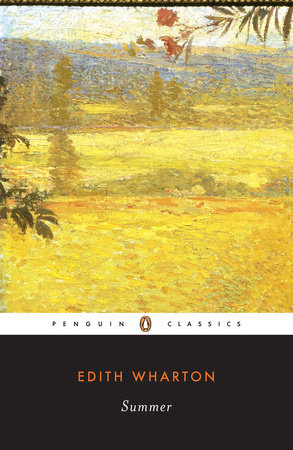
Summer in Winter

On this official last day of winter, with balmier seasons ahead, I thought it appropriate to revisit Wharton’s oft-neglected novella to postulate something that may or may not have had an effect on her characters, plot, and ending: what would Summer have been like had Wharton set the story in winter, like her Ethan Frome??

The novella begins as thus:

“It was the beginning of a June afternoon. The springlike transparent sky shed a rain of silver sunshine on the roofs of the village, and on the pastures and larchwoods surrounding it. A little wind moved among the round white clouds on the shoulders of the hills, driving their shadows across the fields and down the grassy road that takes the name of the street when it passes through North Dormer. The place lies high and in the open, and lacks the lavish shade of the more protected New England villages. The clump of weeping-willows about the duck pond, and the Norway spruces in front of the Hatchard gate, cast almost the only roadside shadow between lawyer Royall’s house and the point where, at the other end of the village, the road rises above the church and skirts the black hemlock wall enclosing the cemetery.”

It is easy to observe the contrast here. Wharton would have you believe that the setting is nothing but warm, pleasant, and bucolic, this put in stark relief against her Ethan Frome, which is an icy tale full of woe and misery. The reader is led towards a positive outlook, perhaps to think that all that is to follow will have a satisfying outcome, a stereotypical “happy ending.” After all, who doesn’t like the weather in June?? And how could any of Wharton’s characters be unhappy in such a dreamy place??

Put under a microscope, however, we are led to something quite different. As readers of Summer, we know that the ending is not ideal, and that her characters, at least her main character, Charity, do not end up particularly happy or satisfied. Charity, like Ethan, is looking for an escape, a chance to break free from her confines, because, to her, this summer landscape is stifling and restrictive. Our minds thereby travel to what the extreme of summer looks, and feels, like at its harshest. The heat and humidity is indeed stifling, and most people do not venture outdoors. The same is true for the winter, in which the drifts of snow and icy temperatures keep most people home bound. So, we can deduce that the extremes of each season leads certain characters, whether in fiction or in real life, to a sort of “cabin fever” effect, where the effects of atmosphere, temperature, and precipitation are prone to driving people to their limits.

And it is this propulsion to the limit that we see affect both Charity and Ethan. It does not matter the season. The extremes of each is what hurtles each character to their individual, but identical fates. Would Charity have indeed escaped North Dormer had Wharton set the story in the winter?? Would Charity have been more resourceful, or more inspired to break free had the winter had its grip on North Dormer?? And inversely, would Ethan have had better luck escaping Starkfield had Wharton set his story in the summer?? It behooves the reader to conclude that, no, it does not matter for Charity or Ethan whether it is summer or winter. We see the glimpses into their identical fates, which ultimately lead to their spiritual destruction. It is evident and foreshadowed in the passage quoted above, where the road ends, just as Charity and Ethan’s stories end, in a place of death, the cemetery.

Readers ultimately mourn for and empathize with Charity and Ethan. But it is at Wharton’s hand that we see their fates played out in the harshest ways. Wharton, in her time, had to bring her characters to such extremes to light attention to the plight of rural men and women of her era. For such people, there were few opportunities for escape or improvement. What we normally observe as the change of seasons in the most delightful of ways were mechanisms of torture for her characters. And perhaps once that warm summer sun pokes over the horizon, or the first snow of winter blows our direction, we’ll remember them more profoundly.

***Stay tuned for more posts!! This June, I will be attending the Edith Wharton Summit 2026 in Lenox, Massachusetts!! So, I look forward to having a plethora of material for future content. Enjoy, and Happy Spring!!
Fables and Fiction: Wharton and “The Age of … Relevance”

“Fiction is the chief intellectual stimulus of our time […] It is ninety-nine chances out of one hundred that the book which, at any given moment, is making the world talk, and making the world think, is a novel.”

–Novel Writing, and Novel Reading (1899), lecture by William Dean Howells

Recently, I have begun to notice something interesting in the things that are “trending” across social media, the web, and (it appears) contemporary literary circles. On my Facebook feed, someone had shared a link to an article titled “Science Shows Something Surprising About People Who Still Read Fiction.” Google’s Zeitgeist commemorative video of the “Year in Search” (2014) revealed that people had searched for “science more than fiction.” And a newly published essay by Roger Grenier in The American Scholar magazine is aptly dubbed “Last Works: Is There Anything Left to Say?”

I loved fiction growing up, and mostly, that was the only kind of reading I did … (I think that’s the only kind of reading most pre-adolescent kids do if there isn’t something more interesting on television, or as a last-resort alternative to spending a weekend or summer away from having to read for homework, and the like) … But I think that it is safer to assume that everyone learns about the world, and themselves, through storytelling. The oral tradition, before the advent of the printing press, had handed down the epic fables, the chronological, biblical tales recorded in story format that were eventually compiled into the Old and New Testaments of the Holy Bible, the text that most everyone already knows is the single most reproduced collection of “stories” ever published … and at the turn of the previous century, the novel had become the premier, ultimate reflection of society’s ability to not just tell and write their own stories, but to turn storytelling, in novel form, into art:

“… The place occupied in the world by the prolonged prose fable has become, in our time, among the incidents of literature, the most surprising example to be named of swift and extravagant growth, a development beyond the measure of every early appearance […] It arrived in truth, the novel, late at self-consciousness, but it has done it’s utmost ever since to make up for lost opportunities. The flood at present swells and swells, threatening the whole field of letters […] The book, in the Anglo-Saxon world, is almost everywhere, and it is in the form of the voluminous prose fable that we see it penetrate easiest and furthest.”

–The Future of the Novel (1900), Henry James, essay

Wharton, encouraged by Henry James, took every advantage of the contemporary trend of the “prolonged prose fable,” and used not only her talent and foresight to populate the imaginations of her readers, but her understanding of the power of the fable.

The fable is, by meager definition: “a short story … conveying a moral.” A few of Wharton’s more successful works are, if measured by their length, technically considered fables (or novellas — Ethan Frome, Summer), but her three most distinctive, novel-length works — The House of Mirth, The Custom of the Country, and The Age of Innocence — would more appropriately fall under James’ heading of the “prolonged prose fable.” It was these novels that mirrored the “zeitgeist” of Edwardian New York society. If there were any hashtags placed before words in private, written correspondence, they would have probably gone before the titles of novels such as Wharton’s.

Perhaps the novel form that Wharton perfected is truly not as relevant or as popular a force today as it was then, nor as singular an indicator of the spirit, tone, and interests of contemporary American society. Since the turn of the previous century, more modes of expression have emerged to conduct the electricity of storytelling, and the power that it brings to individual life. And perhaps also, the use of the novel as a conductor of storytelling is not as favored or as preferred by artists as it once was by Wharton and James.

Yet the story itself remains. The fable remains. And even if everyone across the globe were robbed in an instant of their ability to read and to write, the need to tell stories would remain, to turn stories (events) into fables (lessons). A return to the oral tradition, in an ironic way.

In this sense, I believe that there is no “Age of Relevance” for the story and the fable. Turning one into the other — whether in a novel, on television, on YouTube, in the theater, in graffiti color on a wall of a neglected underpass, in a journal or a notebook or a time capsule that no one may ever see — is a kind of expression, a kind of fiction, that will never die with time, and that telling our own cultural and personal stories, whether in more direct ways, or using fiction as a filter, is a priority that cannot be ignored.

It seems apparent that Wharton, and other American writers who followed, were conscious that the novel would become a sort of “dying breed” of written expression. But there is no doubt (in my mind) that most of these writers, including Wharton, would not be so scathing enough to entirely disapprove of the different modes of media and expression and communication that most everyone is familiar with today …

Distracting? Yes. Detracting? Perhaps. But irrelevant? Far from it.

Blog at WordPress.com.

Up ↑